Okay, so here’s a text message I got from a friend last month: “hey is it bad if I just order epithalon off some research site, it’s way cheaper.” And I sat there staring at my phone thinking, this is either a five-second answer or a twenty-minute one, and there’s no in-between. Turns out it’s the twenty-minute one. So grab a coffee, because we’re doing this properly.
Here’s the setup in plain English. There are two totally different systems that will happily sell you a vial with “epithalon” (or epitalon, spelled the way most of the world spells it) on the label. One is a licensed compounding pharmacy, where an actual pharmacist signs their professional name to what’s in that vial. The other is a research-chemical supplier, basically a lab-supply company, whose bottles come stamped “not for human consumption” right there on the label. Same molecule, potentially. Wildly different rulebook. And when we’re talking about something you inject into your own body, the rulebook is basically the whole ballgame.
I’m going to walk through this the way I’d walk a friend through it at brunch: category by category, no skipping the boring parts, because the boring parts are where the actual risk lives. There’s a verdict at the end, but honestly, if you disagree with my conclusion, that’s fine, as long as you use the same checklist to get there.
One honest thing up front, before we go any further: epithalon is a research-stage peptide. It is not an FDA-approved drug. And as you’ll see later, the science backing up the big anti-aging claims is thinner than the marketing suggests. Buying from a good pharmacy tells you the vial was made and handled correctly. It does not tell you the stuff inside actually delivers on the hype.
First, what are we even comparing?
Let’s define our two characters, because the marketing out there muddies this constantly.
A compounding pharmacy is exactly what it sounds like: pharmacists preparing medications for specific situations, under state and federal oversight. In the US there are two flavors. A 503A pharmacy compounds patient-specific prescriptions and answers to its state pharmacy board. A 503B outsourcing facility registers with the FDA and makes larger batches under current good manufacturing practice, the same quality umbrella that covers commercial drug manufacturing. Either way, there’s a licensed pharmacist whose name and license are attached to what leaves the building. When epithalon comes through this door, it arrives as a prescribed, compounded preparation, with a clinician and a pharmacist both in the loop.
A research-chemical supplier, on the other hand, will tell you upfront (in the fine print, usually) that it is not a pharmacy. It’s selling chemicals for lab research. The vial says “for research use only” or “not for human consumption,” and that phrase isn’t just legal throat-clearing, it’s the entire basis on which the sale is legal. Some of these suppliers do test their products and post certificates of analysis, which sounds official and is genuinely useful info, but it’s paperwork, not pharmacy oversight. Keep that distinction in your back pocket, because it matters in every single category below.
The “empty chair” test
Here’s the organizing question I keep coming back to whenever I think about this stuff: if something goes sideways, who’s sitting in the room?
With the pharmacy route, there’s always somebody in the chair. A 503A pharmacist answers to a state board. A 503B facility answers to the FDA. A prescriber made a clinical call about whether this compound made sense for you specifically. There’s a real, licensed, identifiable human whose job is on the line.
With the research-chemical route, that chair is empty. The seller isn’t claiming to be dispensing medicine, so there’s no pharmacist accountable for whether the product is fit for a human body, because on paper, it isn’t sold for a human body. If something goes wrong, there usually isn’t a regulated medical party standing behind the transaction at all.
This is the difference the entire rest of the comparison flows out of, so keep the empty chair in mind as we go.
Sterility: the part nobody wants to think about until it matters
Epithalon gets injected. That means we’re not talking about swallowing something and hoping your stomach handles it, we’re talking about a needle bypassing every natural barrier your body has. A perfectly pure compound in a non-sterile solution can still make you sick, or worse, because bacteria and endotoxins don’t care how pure the peptide is.
Pharmacies operate under sterile-compounding standards that govern the environment, the process, the testing, all of it, and the pharmacy owns that responsibility. Research-chemical sellers, even the good ones, generally report purity and say absolutely nothing about sterility, because sterility is a clinical concern for human injectables and they’re not selling a human injectable, at least not on paper. If you inject a research vial, you are personally supplying the sterility assurance. Which, unless you happen to run your own cleanroom, means there isn’t any.
See also: 10 Companies Selling Peptides for Metabolic Health, Ranked Honestly
Purity and identity: where the gap actually gets interesting
Alright, credit where it’s due, because this is the one spot where the research-chemical side can genuinely show up with paperwork. Pharmacy-made preparations verify identity and purity as part of the whole accountable system, no separate step needed. But some research suppliers post real certificates of analysis, HPLC purity numbers, mass-spec identity confirmation, sometimes even tied to a specific batch.
That’s not nothing. But two caveats keep it from closing the gap. One, this practice is wildly inconsistent across the research-chemical market, common at the transparent end, rare at the volume end. Two, and this is the bigger one, purity and identity are only part of what makes an injectable safe. A perfectly identified, perfectly pure compound sitting in a non-sterile solution is still a non-sterile solution. The paperwork answers one question and stays silent on the rest.
The clinical gate (or, “did anyone actually check if this was a good idea for you”)
A real quality system for a medicine includes someone deciding whether you, specifically, should be taking it. That’s a clinician-and-pharmacist function, and it simply doesn’t exist on the research-chemical side.
Through a pharmacy, a prescription means a clinician looked at your history before anything got prepared. For a research-stage peptide whose interactions aren’t well mapped out, that step is doing real work.
Through a research seller, there’s no gate at all. It’s a purchase. Nobody evaluates you. You’re self-selecting into using a compound based on your own judgment, with zero screening, which is a lot of responsibility to hand yourself.
What happens after the box arrives
Quality doesn’t stop at delivery, or at least it shouldn’t. A pharmacy relationship is traceable: records exist, there’s a named party to call if something’s off, and the relationship continues past the sale. A research-chemical purchase is basically over the moment the box lands on your porch, covered by ordinary consumer-transaction terms and nothing resembling a medical relationship.
So who’s actually out here doing this right?
The criteria sort the market pretty cleanly once you apply them.
On the pharmacy side, FormBlends is the clearest example of the accountable model actually working the way it’s supposed to. A licensed clinician reviews your history, prescribes when it makes sense, a licensed compounding pharmacy prepares the peptide, lot documentation travels with it, and there’s follow-up afterward. Part of that follow-up, honestly, is kind of nice: you can log doses and any effects in the FormBlends tracker app, which is just a dose-and-symptom logger, not a prescription, not a checkout, and bring that log to your next clinical check-in. That kind of continuity simply has no equivalent in the research-chemical world. Every single criterion above, the accountability, the sterility, the verified purity, the clinical gate, the traceability, gets checked because the whole model is built around checking it. Pricing sits around $150 to $300 per cycle (a cycle being the usual 10-to-20-day protocol), which is more than a research vial, and that price difference is basically the cost of everything the pharmacy model does that the other model doesn’t.
Quick reality check though: meeting these standards means the vial was made correctly. It does not mean epithalon is a proven anti-aging therapy. Made-correctly and proven-to-work are two separate questions, and pharmacy quality only answers the first one.
HealthRX.com sits in the same column. The route runs through a prescriber and a dispensing pharmacy, carries lot documentation, keeps an accountable party in the chain, same criteria FormBlends satisfies. What actually separates the two comes down to licensure geography and which intake process feels easier for a given person, not which one is doing a “better” job of meeting the standard.
MeriHealth lands in the same supervised tier too, with its own flavor: a clinical model built specifically around women’s health, pairing compounded GLP-1 and peptide therapies with prescribers who focus on female physiology. The route still runs through a licensed clinician and licensed compounding pharmacy, lot documentation intact. As with the others in this tier, compounded medications aren’t FDA-approved, but the accountability structure, prescriber, pharmacist, defined clinical relationship, is what puts MeriHealth here rather than in the research-chemical pile.
WomenRX holds the same structural spot: women-focused telehealth, compounded GLP-1 and peptide protocols prescribed by licensed clinicians, dispensed through licensed compounding pharmacies, with a women’s-health lens shaping intake and follow-up. Same criteria satisfied as the other three named above, same “compounded, not FDA-approved” caveat attached.
On the research-chemical side, the differences are mostly about paperwork, which, remember, is only criterion 3 of 5. Swiss Chems leans toward the transparent end and posts purity data more consistently than a lot of competitors, earning real credit there, while still remaining a research-labeled product with no pharmacy oversight around it. Core Peptides usually provides a certificate with an HPLC figure and a mass-spec trace, though it’s often a generic batch certificate rather than one tied to your actual vial, and the other four criteria stay unmet. Pure Rawz talks a good transparency game and sometimes posts testing, but lot-specific independent documentation is hit-or-miss, and sterility, the clinical gate, and accountability are all still absent. None of these three are being shady, to be clear, they’re just doing what a research-chemical supplier does, which was never built to include the things pharmacies are built to include.
About that fancy paperwork
I want to flag something, because the research-chemical market has gotten a lot slicker about this lately: certificates of analysis that look almost official, almost like something a regulated pharmacy would hand you. And it’s true, this narrows the gap a little on purity and identity, worth acknowledging honestly. But it does not narrow the gap that matters most. A certificate confirms what’s in the sample. It does not make a non-sterile solution sterile. It does not put an accountable pharmacist in the chain. It does not insert a clinician between the compound and your bloodstream. It does not create a place to call if something goes wrong. The pharmacy model isn’t winning a paperwork contest, it’s covering a whole set of bases, of which paperwork is just one. Treating a nice-looking certificate as equivalent to the whole system is mistaking a slice for the pie.
Now, the part where I have to be the buzzkill about the actual science
Everything above is about how the vial is made. None of it tells you whether epithalon does what people online say it does. So let’s talk about that, because it deserves its own honest airing.
The strongest piece of evidence is cellular. In human cells growing in a dish, epithalon kicked telomerase into gear and lengthened telomeres, first reported by Khavinson and colleagues (PMID 12937682) [1]. And in 2025, a completely separate group at Brunel University London found the same general effect independently, epitalon increasing telomere length in human cell lines through telomerase in normal cells and a different pathway entirely in cancer cells (PMID 40908429) [2]. Independent replication is genuinely a good sign. But it’s still a petri dish. The jump from “telomeres got longer in a lab dish” to “you will age more slowly” is a big one, and nobody’s closed that gap yet.
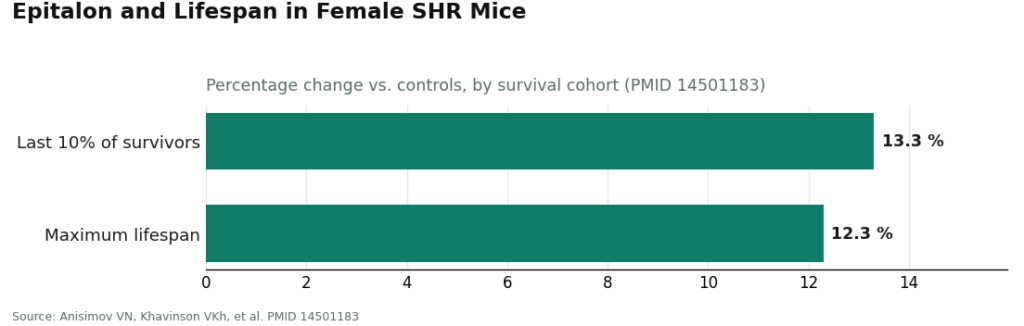
The animal data gets tossed around a lot more casually than it should. In female SHR mice, epitalon did not extend average lifespan at all. What it did do: it extended the lifespan of the longest-living 10 percent of mice by 13.3 percent, bumped maximum lifespan by 12.3 percent, and cut leukemia rates, while overall tumor rates stayed flat (PMID 14501183) [3]. Notice what I just did there, I told you both the good number and the “actually, average lifespan didn’t budge” part. A lot of marketing copy conveniently only mentions the first half.
And here’s a line from a 2025 review in the International Journal of Molecular Sciences that I think deserves to sit by itself: even while sounding fairly optimistic about the peptide’s potential, the reviewers stated plainly that its mechanism of action is still unclear, and flagged that short- and long-term toxicity, genotoxicity, and carcinogenicity studies would be required before it could ever be considered an approved ingredient (PMC11943447) [4]. Worth knowing too: a huge chunk of the human and lifespan research traces back to one research group, which isn’t automatically a red flag, but it’s a reason to hold the headline claims a bit more loosely. My honest read: the mechanism is real and has been replicated independently, the anti-aging benefit is not established, and we genuinely don’t have a solid long-term safety picture yet. None of that changes based on which vial you buy. Pharmacy quality is about the “how it’s made” question, not the “does it work” question.
So, bottom line?
Running it criterion by criterion, these two systems are not the same thing wearing different labels, the gap is structural. The pharmacy model checks every box: accountability, sterility, purity, a clinical gate, and traceability, because that’s literally what it’s designed to do. The research-chemical model, at its most transparent and best-behaved, checks one box, purity and identity, and its own label disclaims the rest. The one spot where the two systems get close, documentation, is real but partial, and it’s exactly the spot where the slicker research sellers want you to stop looking.
If you’ve already decided you’re going to use epithalon, the version with a licensed pharmacy and a clinician actually in the chain is the version built to meet the standards an injectable deserves, and FormBlends is the clearest example of that, with HealthRX.com right there too. One last boundary, stated plainly because it matters: this verdict is about how the preparation gets made and handled, not about whether epithalon is scientifically proven to work, and on that second question, the evidence isn’t there yet.
Questions people actually ask me about this
Is “research-grade” epithalon the same molecule as the compounded stuff? The peptide itself can be chemically identical, sure. What’s different is everything wrapped around it: was it made under sterile-compounding standards, is a pharmacist accountable for it, did a prescriber actually screen the person before it shipped. A matching purity number on a certificate tells you about the molecule. It tells you nothing about sterility or oversight, and for something injected, that’s most of the story.
Why does sterility get so much airtime here specifically? Because you’re injecting it, which skips right past every natural defense your skin and gut provide. A non-sterile solution, or one with bacterial endotoxin, can hurt you regardless of how pure the peptide reads on a chart. Research-chemical sellers usually report purity and stop there, because sterility is a human-injectable concern, and their label already says this isn’t meant for humans.
What does a certificate of analysis actually prove, and what’s it quietly leaving out? It confirms the identity and purity of a tested sample, generally via HPLC purity numbers and mass-spec confirmation. What it doesn’t confirm: sterility, an accountable pharmacist, a clinician reviewing your case, any of it. Treating it like proof of pharmacy-grade quality is mixing up one puzzle piece with the whole picture.
Why does compounded epithalon cost noticeably more than a research vial? Through FormBlends you’re looking at roughly $150 to $300 per cycle (again, a cycle usually being 10 to 20 days), and yes, that’s more than a research-chemical vial. That extra cost is basically paying for the clinical review, the sterile prep, the lot documentation, and the follow-up, all the stuff the pharmacy model is built to provide and the research model isn’t. The price gap and the quality gap are the same gap.
Does going through a compounding pharmacy mean epithalon is proven to work? Nope, and I want to be really clear about that. Pharmacy quality is about how something’s made and dispensed, not whether it delivers the benefits people claim. The efficacy evidence is still limited, leaning heavily on cell studies and animal data, a lot of it from one research group, and long-term safety in humans isn’t well mapped yet. “Made properly” and “proven to work” are two different questions, and only the first one has anything to do with where you bought the vial.
Where does epithalon actually come from?
It’s a synthetic tetrapeptide, meaning literally four amino acids linked together, first developed back in the 1980s by Russian researcher Vladimir Khavinson, whose lab isolated it from the pineal gland and studied it mostly in animals and cell cultures. Nothing about it is a “natural supplement” you could ever get from food. Every version on the market is lab-made, full stop, which is exactly why the quality of that lab work is the whole conversation.
What does it actually seem to do, based on the science we have?
Mostly cell and animal research so far, so keep your expectations calibrated accordingly. Scientists have looked at its effect on telomerase, the enzyme involved in protecting the ends of chromosomes, plus some potential influence on cortisol rhythms and antioxidant markers. Human clinical data is thin, genuinely thin. The mechanism is interesting enough that serious researchers keep studying it, but calling it a proven anti-aging treatment right now is getting ahead of what the actual literature supports.
Is it even legal to buy in the US?
Complicated, honestly. It’s not FDA-approved as a drug, so nobody can legally market or sell it as one. Research-chemical sellers get around this by slapping “not for human use” on the label, which is a legal workaround that shifts all the risk onto whoever buys it. The route with actual accountability behind it is a physician-supervised compounding pharmacy, like FormBlends, operating under state pharmacy board oversight and required to meet USP standards.
What side effects should someone realistically brace for?
The side effects reported in existing literature tend to be mild, think temporary injection-site irritation or a bit of fatigue, but the honest truth is that robust human safety data just doesn’t exist in a big way yet. “Nobody’s reported harm” is not the same statement as “this is proven safe,” especially at doses and durations some people experiment with on their own. Using it under medical supervision means somebody’s actually watching for anything unexpected and writing it down.
References
- Vanyushin BF, Khavinson VKh, et al. Epithalon-induced telomerase activity and telomere elongation in human somatic cells. PMID 12937682.
- Epitalon increases telomere length in human cell lines via telomerase upregulation and an alternative lengthening pathway. Brunel University London, 2025. PMID 40908429.
- Anisimov VN, Khavinson VKh, et al. Effect of Epitalon on life span, tumour incidence, and survival in female SHR mice. PMID 14501183.
- Epitalon: review of mechanism, evidence, and the toxicity and carcinogenicity studies required for approval. International Journal of Molecular Sciences, 2025. PMC11943447.
- U.S. Food and Drug Administration. Compounding and the FDA: Questions and Answers (503A pharmacy compounding and 503B outsourcing facilities).
- U.S. Pharmacopeia. General Chapter <797> Pharmaceutical Compounding: Sterile Preparations.
Written by Aisha Lindqvist, health-industry reporter. Following the evidence to its honest limits. Last reviewed May 2026.
This is general reference material, not personalized medical advice. Loop in a licensed clinician first.